Thursday, August 18, 2011

Moving onto Belize


After 6 weeks in Mexico I was ready for a change and a new beginning. Charissa Scott, a Welsh woman who was at the Marine conservation camp, and I decided to head there together to do some more diving and check out the local scene.

We decided to cross the border via water taxi from Chetemal. Immediately we discovered Belize was a VERY friendly place. The language is English which made it instantly easier for us to mingle with the locals.

Our first stop, after a very easy immigration and customs process was San Pedro. We only had an hour here but that was enough time to walk around the streets and realise that we wanted to come back here. We caught the boat for the second leg of our trip to Caye Caulker.

We found some lovely beach cabanas and decided to stay for three nights. This little gorgeous island is a tourist mecca. There are no cars on the island and most people get around on push bikes or ride in golf carts. The logo for Caye Caulker has a tagline “Go Slow”, and we soon understood what that meant, when we sat down for our first meal. The service is very casual, often taking a half hour before you get any attention for ordering your meal. Then about an hour before you eat.

The main attraction to the island (Caye) is the water activities. You are spoiled for choice for diving, snorkeling, para sailing etc. We decide to go on a dive out to the outer reef with Belize Diving Services. From 4 operators we spoke to, they seemed the best equipped and professional.

On route to the dive site we did have a number of dolphins riding our the bow of the boat. The diving itself was nice, but there was very little that I hadn’t seen before. There was quite a number of Southern Stingrays though, and the fish seemed very relaxed around divers. We had some very friendly barracudas and a HUGE Green Moray Eel, about two meters long with a head the size of a basketball.

Watch the dolphins riding the bow of our diving boat here…
Dolphins Belize

See more pictures of Caye Caulker here...
Bridgette's Photostream - San Pedro

Wednesday, August 10, 2011

Diving Cenotes


If you are a diver and you come to Mexico, high on the list of things to do is to dive in a Cenote. A Cenote is basically an underground cave, that is full of water. There are hundreds, perhaps thousands here and can offer a very different diving experience.

The closest and the best (so our dive leader told us) to Playa del Carmen is that of Cenote Chac Mool .

Walking into the jungle with my diving gear and two full wetsuits was a strange experience. I was quickly getting very hot in all this gear and the immense heat. But once I got into the water I could see why the two wetsuits were needed. It was COLD!!

The cenotes are fresh water on the surface, and at some depths that water is salty. The density keeps the salty water at the bottom. Seeing the layers of the different waters is something extraordinary to see and they call this the Halocline zone. It is almost like going into another dimension or timeshift like in Stargate. Almost impossible to capture on film it really is something one needs to experience first hand.

During the dive we surfaced in an air pocket to see stalagmites, stalactites and tree roots. There was a small amount of fresh water fish in the cenotes and we also saw a crayfish. Sometimes you could see beams of sunlight coming into the fresh water and you could see thru to trees above in some patches.

See more pictures here…
Bridgette Gower’s Photostream – Diving Cenotes

Diving in Cozumel


“Some of the best diving in the world” is what I have heard about Cozumel. It was made famous by Jacques Cousteau when he visited here in 1960 and introduced the world to the amazing corals and tropical fish on Palancar Reef. I had high expectations. I was not disappointed.

A bottlenose dolphin greeted us as we entered the area, and once we stopped at the dive site there was a loggerhead turtle basking on the surface.

Once descended I was immediately impressed with the absolute beauty of the reef. Large colourful coral and fish enmasse lured me in. Within 2 minutes of the dive, we saw a Nurse Shark. I was also very happy to see a pair of Scrawled Filefish, which was on the target fish species on the Marine Conservation Project, but didn’t see one. Also on the target fish list was the beautiful Sargassum Trigger, a massive Goliath Grouper, about 4 foot long, and the very elusive Queen Parrotfish. Also quite prevalent on the reef, unlike at Punta Gruesa were Queen Angelfish.

About a third of my way through the first dive I became incredibly thankful of all my diving training when the cap of my regulator broke and I found I was breathing water. I quickly yanked out my secondary air source hose and started to breath again. Yes, I was in Mexico! But this kind of thing can easily be avoided by diving companies if gear is maintained regularly. Needless to say, all the other divers and the staff were not impressed with the equipment I hired. Neither was I and I was sure to complain once I returned the gear.

My diving continued without any other problems and I enjoyed the beautiful scenery. The current was quite strong and I enjoyed the feeling of flying over the reef. I saw many lobsters hiding away in caves, some lovely big Midnight Parrotfish, and Ocean Triggerfish.

I was really impressed with the diving here. It’s going to be really hard to top.

Tulum Ruins

A visit to the Tulum ruins was to be my first visit to any of the many ancient Mayan ruins that graced Mexico, Middle and South America. My first impression of them was that the Mayan royalty and people of power must have lived a very lovely life. The location of Tulum is absolutely stunning with a wealth of natural beauty.

The site of the ancient ruins has been kept as natural as possible. Unlike many ancient sites that have become so commercial and ruined by tourism, Tulum remains relatively unscathed.

It took about 2 hours to walk slowly around the site, stopping to pose for a few pictures here and there as well as having a little swim in the gorgeous beach that the Mayans would have used.

See more pics here…
Bridgette’s Flickr Photostream – Tulum Ruins


Swim with Whale Sharks


On our first day off after completing our Marine Conservation Project, Charissa & I decided to swim with Whale Sharks. After visiting several dive shops and speaking to a few people to get a sense of the experience we decided to book with an Eco Tour Group who emphasized conservation and protection of these beautiful creatures.

Swimming with Whale Sharks has been a dream of mine for many years and this was the first time I have been in the right place at the right time to see them. I quickly learned that I had timed it perfectly. Yesterday they saw 20 sharks!

Whale Sharks congregate here during May to September to filter feed on plankton and other small marine creatures. Swimming with them was a major business in and around the Caribbean. When I heard at first that there was going to be 50 boats a day visiting the sharks I was concerned that it was a huge invasion of their behavior and felt bad about my decision to do it. I also knew that in some countries they have them in aquariums, which I believe is a disgusting abuse of this magnificent animal. It reminded me that seeing them in their natural state was far better than seeing them in an aquarium.

We arrived in Cancun to the boat that would take us 1-hour north. There were 10 of us plus 2 dive leaders in the boat. We were briefed on the rules for the day which included only 2 people at a time would swim with the shark, not touching the shark, staying 2 metres from the sharks head and 4 metres from the sharks tail. I was happy to adhere to these rules. Even though these are gentle giants, they could certainly inflict some damage if you were too close to the tail, or the head, however they don’t really have teeth that would cause much damage. We were also given a short lecture about the Whale Shark explaining their anatomy, diet, behavior and habitats.

After only 20 minutes in the boat, other operators in the area had passed on coordinates via the radio. We were not far away. It was only minutes and we slowed the boat to 1 or 2 knots. It was then we started to see evidence of the sharks by their dorsal fin and tail swimming the waters surface. We soon realised that there was probably at least 50 sharks here, perhaps more. The boats were very spread out, kilometers apart, and there were sharks without boats next to them. Happy Days! I didn’t feel so bad about invading their territory.

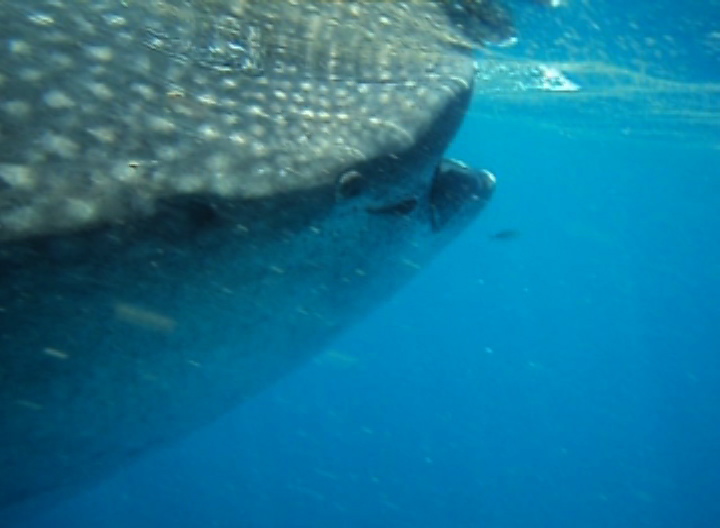
Our first encounter was an extreme close-up look at one shark came alongside our boat and proceeded to go directly underneath the bow. Incredible!

My first swim, I decided to just go solo, leaving the camera behind so I could just enjoy the experience. I found myself quickly next to the shark and swimming at a furious pace in order to keep up. Adrenaline was pumping hard from excitement! Swimming with this creature was surreal. At least 5 times the length of my body, a head as wide as I am tall, and whose tail is taller than I am, this enormous animal swam with such grace and elegance. I had a good 5-minute swim before I was completely exhausted and stopped so the boat could pick me up.

The second swim, I decided to take my camera and try out the new housing I bought for the occasion. We got in the water and swam furiously towards the shark, but this one was too fast for us to catch up with and we never got more than 4 meters from the tail.

Our 3rd and final swim was by far the best and longest. A whole seven and a half minutes right alongside a huge slow swimming male. I got so close I could have touched and at one point I was only centimeters away when he changed course I was just above his pectoral fin. I kept up with his head for a time, then allowed myself to drop back alongside and went behind the tail, then came up on the other side and up to the head again. I watched him as he swam mouth agape scooping up plankton and fish roe off the surface of the water. He even had a few small fish riding the bow in front of his enormous mouth. Underneath him were a few remoras enjoying the ride.

What an experience! At the very end of the swim, I dropped back to wait for Charissa to join me so we could get back on the boat. She pointed to something in the water. A marlin was following the shark. What a bonus!

On the return trip we spoke to the dive leader and he estimated that there was probably over a 100 sharks there that day. AMAZING!!

Watch my video here...
Whale Shark encounter in Mexico

See more pictures here...
Bridgette’s Flickr Photostream – Whale Shark Swim


Giant Iguanas


On Banco Chinchorro we were greeted by several friendly Giant Iguanas.

Marine Expedition Base Camp Week 5 – final week


Week five on the Marine Conservation Project was all about practicing the monitoring procedure to start collecting data. It was at this point that many of us that signed on for the five week project, came to realize that it was unlikely that our efforts would achieve data collection that would be sent on to the Amigos de Sian Ka’an, A.C. (ASK) and the University of Quintana Roo. This was due to the strict guidelines in order to ensure the collation of data was accurate. Knowing this was a little disappointing, however after discussions with staff and a conclusion lecture about what our 5 weeks meant assured us that we didn’t waste our time. Incidental sightings of mega fauna, like turtles, sharks and rays that we collected that would be sent on. Also we recorded any sighting of lionfish, as their numbers have become a big problem in the Caribbean. It was explained that our project is the only group that participates in bird monitoring in the whole of Mexico’s state Quintana Roo. We also did weekly beach cleans that we collected information on different types of rubbish and quantities. This information was all sent onto different relevant bodies.

I can safely say though, if nothing else, my diving has improved so much that I am now very confident at depths over 20 metres, am using less air while diving and almost perfect buoyancy which means that I am unlikely to damage any coral while diving due to touching or grazing the reef. Other skills of setting up our own gear daily, using compressors to fill the tanks, and being on the base radio were all great skills to have. Above everything else, it is absolutely wonderful to know now what kinds of fish species I am looking at when I’m diving. It makes it so much more exciting when you know it’s something rare that you are seeing.

On the Wednesday of week 5, I had my 50th dive. A friend of mine, Charissa Scott from Wales, also had her 50th dive a week before but didn’t get the chance to celebrate it. So we took it upon ourselves to celebrate it by doing a naked dive! Now this in itself was also a chance to improve our skills underwater. We got into the water with a bikini and all of our SCUBA gear on, then descended to 12 metres where one at a time, disconnected our BC (Buoyancy Control) vests so we could remove our bikini. Then holding our purpose made signs strategically placed, we took photos. Stylin!

The remainder of the week was fun diving and I had some beautiful dives in which I saw a Scrawled Cow Fish and some African Pompano. Very cool to see!

The last day or two was bitter sweet, knowing that I would be now moving on to do some solitary traveling and starting my own adventures, but leaving behind a great group of people and some great friends I have made while on the project.

On the whole I thought the project was fantastic and all the staff were inspiring in different ways. I am very impressed with GVI as a well-run international company with a fantastic philosophy and amazing partnerships.

See more pictures at....
Bridgette’s Flickerstream of Punta Gruesa